
Maritime
NIMASA, MWUN commence review of dock workers’ service conditions for 2026/2028

By Joseph Lucas
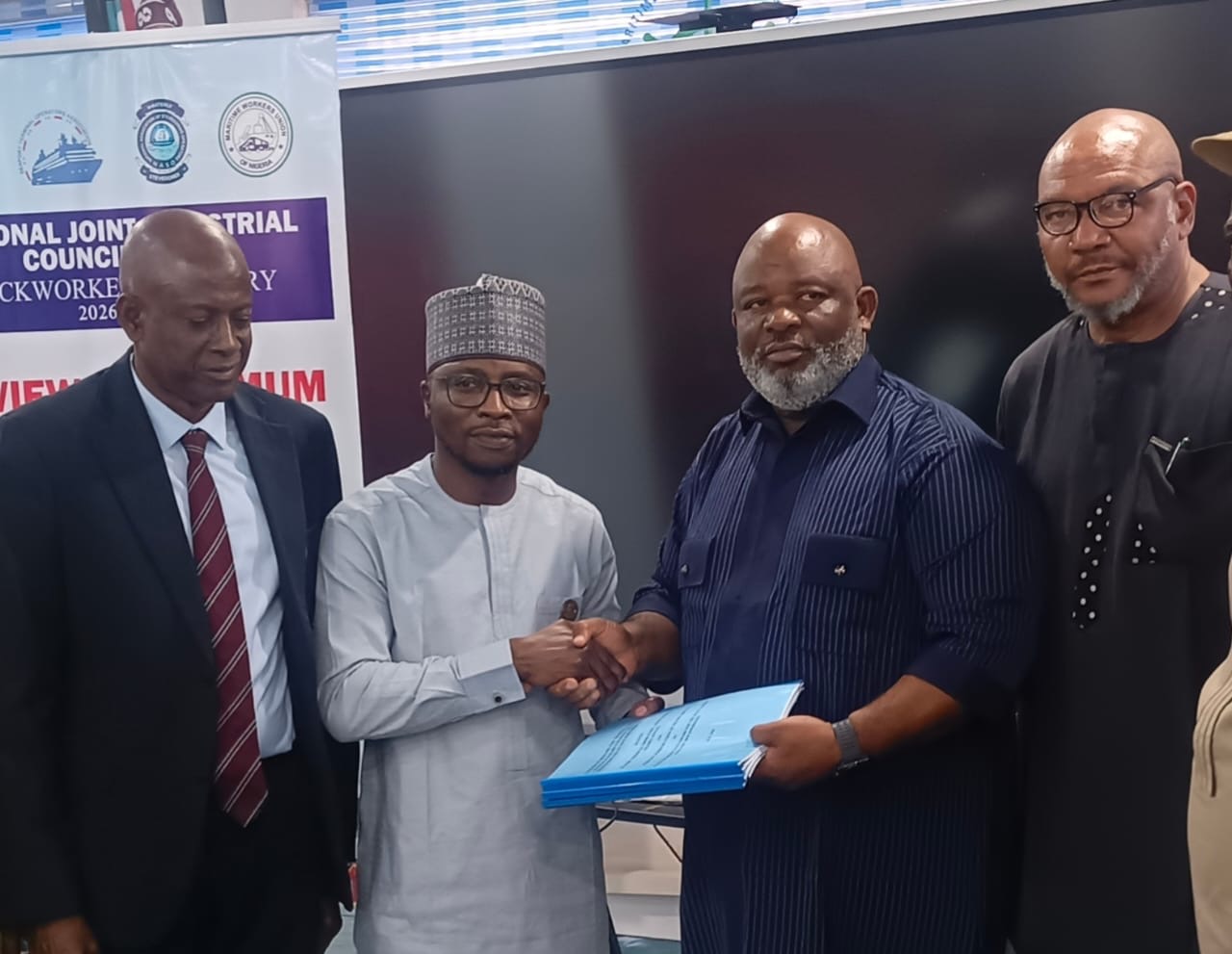
The Nigerian Maritime Administration and Safety Agency, NIMASA, and the Maritime Workers Union of Nigeria, (MWUN), have commenced a review of the minimum standards and conditions of service for dockworkers for the 2026–2028 period. This was the thrust of the reconvened National Joint Industrial Council (NJIC) meeting facilitated by the Agency where presentation of proposals by employers, labour unions and other industry groups took place.
The submissions, which cover wages, workers’ welfare, occupational safety and health, pension provisions, working conditions, protective equipment and skills development, will form the basis for further consultations towards establishing an improved and harmonised framework for the dock labour industry.
Speaking at the meeting, Chairman NJIC who is also the Executive Director, Maritime Labour and Cabotage Services, NIMASA, Mr Jibril Abba, stressed that the welfare, safety and fair treatment of dockworkers remain critical to efficient port operations and the overall competitiveness of Nigeria’s maritime industry.
According to him, “Dockworkers are an indispensable part of the maritime value chain. Ensuring fair remuneration, decent working conditions, adequate safety provisions and opportunities for professional development is not only a labour issue but also fundamental to the efficiency and sustainability of our ports.”
He noted that the review was necessary to address existing disparities in wages and employment conditions, strengthen compliance with industry standards and respond to changing operational realities driven by technology and evolving port activities. He urged all parties to approach the process with a shared commitment to fairness, mutual understanding and industrial harmony.
In his remarks, the President-General of the Maritime Workers’ Union of Nigeria (MWUN), Comrade Francis Bunu, commended NIMASA for providing a platform for sustained engagement between workers and employers. He emphasised the need for the review to be concluded promptly and translated into tangible improvements in workers’ conditions.
Bunu stated, “We appreciate NIMASA’s continued engagement with the maritime labour community. What is important is that this process delivers practical benefits to dockworkers. The agreement must go beyond words on paper and ensure improved welfare, better working conditions and sustained industrial peace in our ports.”
The NJIC provides a structured platform for government, employers and organised labour to negotiate minimum conditions of service, promote decent work and strengthen industrial relations in the dock labour sector.
NIMASA reaffirmed its commitment to reviewing the submissions and sustaining consultations with stakeholders towards achieving a mutually acceptable framework that balances workers’ welfare with the operational realities of the industry.
At the meeting were members of the Seaport Terminal Operators of Nigeria (STOAN); Oil Producers Trade Section (OPTS); Association of Bonded Terminals Operations of Nigeria (ABTON); National Association of Stevedoring Operators (NASO) and the Maritime Workers’ Union of Nigeria, (MWUN).

By Monireoluwa Lucas
The Lagos seaports recorded 14 criminal cases in the third quarter of 2026, resulting in the loss, damage or theft of property valued at ₦63.949 million, while 37 suspects were arrested, according to police statistics.
The figures were contained in the third-quarter crime report of the Port Authority Police Western Command’s Port Criminal Investigation Department (CID).
The reported offences included stowaway attempts, stealing, obtaining by trick, impersonation and threat to life.
Stowaway attempts and stealing were the most frequently reported offences, accounting for five cases each during the three-month period.
The five stowaway cases led to the arrest of 20 suspects. All the cases were taken to court, and the suspects were convicted.
Similarly, five cases of stealing resulted in the arrest of 13 suspects. Four cases involving 11 suspects were charged to court, while the remaining case involving two suspects was still under investigation.
The police report showed that property worth ₦51.749 million was lost, damaged or stolen through theft, while items valued at ₦200,000 were recovered.
Two cases of obtaining by trick were also recorded, leading to the arrest of two suspects. Both cases remained under investigation, with property worth ₦12.2 million reported lost, damaged or stolen.
However, the police recovered property valued at ₦6.7 million in connection with the offences.
The statistics further revealed that one case of impersonation and another involving threat to life were recorded during the period, with one suspect arrested in each case. Both matters remained under investigation.
A breakdown of the overall figures showed that nine cases involving 31 suspects had been charged to court, while five cases involving six suspects were still under investigation.
Of the 37 suspects arrested, 20 had been convicted, while 11 were awaiting trial.
The police also reported that the total value of recovered property stood at ₦6.9 million.
The figures highlight continuing security challenges at the Lagos seaports, particularly stowaway attempts, theft and fraudulent activities, raising concerns about the protection of maritime assets, port personnel and cargo operations.

By Joseph Lucas
Imports of Premium Motor Spirit (PMS), popularly known as petrol, through Lagos ports declined by 52.23 per cent in November, while bulk wheat remained one of the leading commodities imported into the country during the three-month period.
Figures contained in the Nigerian Ports Authority (NPA) Shipping Position document showed that petrol imports fell to 73,895 metric tonnes in November, compared with 328,231 metric tonnes recorded in October.
Crude oil imports through Lagos ports also recorded a significant decline, dropping from 702,254 metric tonnes in October to zero in November.
Meanwhile, bulk wheat emerged as a major import commodity, with a combined volume of 461,190 metric tonnes recorded between September and November.
According to the NPA document, wheat imports rose to 252,348 metric tonnes in October before declining by 17.24 per cent to 208,842 metric tonnes in November.
Other major commodities imported through Lagos ports during the period included 402,126 metric tonnes of Premium Motor Spirit (PMS), 209,000 metric tonnes of Automotive Gas Oil (AGO), commonly known as diesel, 212,700 metric tonnes of bulk sugar, 150,000 metric tonnes of aviation fuel and 114,263 metric tonnes of bulk salt.
Bulk sugar imports stood at 109,350 metric tonnes in October before declining to 103,400 metric tonnes in November.
In contrast, bulk salt imports recorded a significant increase, rising from 33,000 metric tonnes in October to 81,263 metric tonnes in November.
The NPA report further revealed that Lagos ports received 624 trucks, 157 transformers and three Rubber-Tyred Gantry (RTG) cranes during the period under review, highlighting the range of equipment and cargo handled through the nation’s busiest port complex.
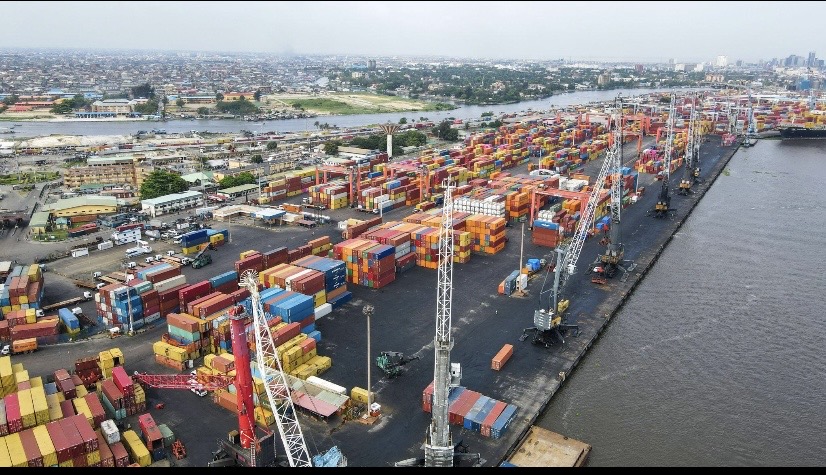
The Federal Government has commenced a ₦1.45tn modernisation and upgrade of the Lagos Port Complex, Apapa, and Tin Can Island Port in a major move to improve port efficiency, reduce cargo handling costs and strengthen Nigeria’s competitiveness in global maritime trade.
The project was officially flagged off on Tuesday at a groundbreaking ceremony held at Tin Can Island Port. The event was attended by the Minister of Marine and Blue Economy, Dr Adegboyega Oyetola; the Minister of Finance and Coordinating Minister of the Economy, Taiwo Oyedele; and other senior government officials.
Speaking at the ceremony, Oyetola described the initiative as a strategic investment aimed at addressing decades of infrastructure deficits, attracting international shipping lines, stimulating industrial development and creating at least 20,000 direct and indirect jobs.
He said the project aligned with President Bola Tinubu’s Renewed Hope Agenda, which identifies infrastructure development as a key driver of economic growth, investment and employment.
According to the minister, the existing facilities at Apapa and Tin Can Island ports have become increasingly inadequate to meet the demands of Nigeria’s growing economy and evolving global shipping requirements.
He noted that Apapa Port, established in 1913, was more than a century old, while Tin Can Island Port was commissioned in 1977 when Nigeria had a population of approximately 67.2 million, annual trade valued at about $17bn and cargo throughput of 8.11 million metric tonnes.
Oyetola said Nigeria’s population had since increased to about 240 million, with annual merchandise trade exceeding $100bn and cargo throughput rising to 129.3 million metric tonnes.
He explained that the sharp increase in economic and trade activities had widened the gap between demand and existing port infrastructure, making comprehensive modernisation unavoidable.
“The cost of inaction is far greater than the cost of modernisation,” he said, stressing that Nigeria could no longer afford to lose its competitive advantage to neighbouring countries.
The minister said the government was targeting increased direct calls by international shipping lines, improved cargo retention, expanded transshipment opportunities and the positioning of Nigerian ports as preferred gateways for trade under the African Continental Free Trade Area (AfCFTA).
He also expressed concern over prolonged cargo clearance and processing times at Nigerian ports, noting that cargo dwell time had historically ranged between 10 and 18 days, compared with three to five days at leading international ports.
According to him, the delays contribute to congestion, demurrage, storage charges and increased logistics expenses, with port inefficiencies estimated to cost the Nigerian economy as much as $4bn annually.
Oyetola explained that the modernisation programme would cover the rehabilitation and upgrading of quay walls and berths, dredging of navigation channels, improvement of access facilities, installation of modern cargo-handling equipment and upgrading of operational systems.
He added that the project would introduce more integrated, efficient and digitally enabled port operations.
The minister expressed confidence that improved port infrastructure would enhance the competitiveness of Nigerian agricultural products, processed foods, solid minerals, manufactured goods, textiles and petrochemical products in regional and international markets.
To minimise disruptions during construction, Oyetola said he had approved the establishment of an Inter-Ministerial Committee comprising the Federal Ministry of Marine and Blue Economy, the Nigerian Ports Authority (NPA) and the Nigeria Ports Economic Regulatory Agency.
The committee, he said, would develop a Port Business Continuity and Cargo Flow Management Plan to coordinate phased construction activities, vessel scheduling, cargo evacuation, truck movements and the use of alternative ports and transportation channels where necessary.
He further disclosed that the Lagos ports upgrade formed part of a broader national maritime transformation programme, which also included the approved modernisation of Onne, Rivers, Delta and Calabar ports.
Also speaking, Oyedele described the project as a significant step towards reducing the cost of doing business, strengthening Nigeria’s economic competitiveness and accelerating growth.
He said improved port operations would reduce delays and related expenses for importers and exporters, enhance the competitiveness of locally produced goods and deliver benefits to manufacturers, farmers and consumers.
The finance minister described the financing arrangement as Nigeria’s largest sovereign export credit transaction since 2009 and the first project undertaken in the country by Poland’s Export Credit Insurance Corporation, KUKE.
He said the transaction reflected growing international confidence in Nigeria’s economic reforms.
Oyedele reaffirmed the Federal Government’s commitment to ensuring timely approvals, maintaining a stable and predictable business environment and promoting transparency throughout the financing and implementation of the project.
In his remarks, the Managing Director of the Nigerian Ports Authority, Dr Abubakar Dantsoho, described the groundbreaking ceremony as a landmark moment in the authority’s history.
He assured stakeholders that the NPA would ensure the project was delivered in accordance with approved designs, engineering standards and contractual timelines.
Dantsoho also pledged effective technical supervision, quality assurance and coordination throughout the construction period, with particular attention to safety, environmental standards and the need to sustain port operations.
The ceremony was attended by Poland’s Deputy Foreign Minister, Marcin Bosacki; Polish Ambassador to Nigeria, Michal Cygan; and the British Deputy High Commissioner in Lagos, Jonny Baxter, alongside contractors, international financing partners and other stakeholders in the maritime industry.



-

 Energy1 year ago
Diesel falls to ₦979/L in Lagos
-

 Law & Crime1 year ago
EFCC vs Yahaya Bello: Court adjourns ₦80.2b alleged fraud trial to Nov 11
-

 Business9 years ago
The 9 worst mistakes you can ever make at work
-
Art & Life9 years ago
These ’90s fashion trends are making a comeback in 2017
-
Entertainment9 years ago
The final 6 ‘Game of Thrones’ episodes might feel like a full season
-
Art & Life9 years ago
According to Dior Couture, this taboo fashion accessory is back
-
Business9 years ago
3 Ways to make your business presentation more relatable
-
Entertainment9 years ago
The old and New Edition cast comes together to perform