features
How policy gaps keep Nigeria dependent on petrol imports

Nigeria’s persistent dependence on imported petrol has become one of the most expensive contradictions in its energy economy. Despite vast crude oil reserves and growing domestic refining capacity, billions of dollars continue to flow abroad each year, draining public finances and foreign exchange. This paradox has intensified scrutiny of regulators and policymakers, with stakeholders demanding decisive reforms that prioritise local refining, restore competitiveness, and finally break the cycle of import dependency.
The call on the country’s newly appointed petroleum sector regulators to make domestic refining and crude oil production top priorities is well founded. For several years, petrol importation has remained a major drain on public finances, costing the government an estimated $18 billion over the past five years alone.
In setting expectations for the new appointees, stakeholders across the oil and gas industry have been unequivocal in their demand that this trend be reversed, warning that it has become a cankerworm eating deep into the economy. The Chief Executive Officer of the Centre for the Promotion of Private Enterprise, Dr. Muda Yusuf, was particularly forthright, cautioning that failure to decisively address the issue would further entrench Nigeria’s dependence on fuel imports and deepen its economic vulnerabilities. He urged both the Nigerian Midstream and Downstream Petroleum Regulatory Authority (NMDPRA) and the Nigerian Upstream Petroleum Regulatory Commission (NUPRC) to pursue policies that reduce import reliance, expand domestic capacity, and attract sustained investment into the oil and gas sector.
According to Yusuf, strong and deliberate support for domestic refining must be treated as an immediate and non-negotiable priority in the downstream segment. He argued that government policy should clearly favour locally refined petroleum products through targeted fiscal, regulatory, and infrastructural incentives for both public and private refineries, while actively encouraging new investments in refining capacity. “Nigeria must end the current distortion whereby imported petroleum products are made to compete with locally refined products under unequal regulatory and fiscal conditions. This does not constitute fair competition. Genuine competition only exists when all operators function within the same policy, tax, and regulatory environment,” he noted.
Yusuf stressed that the argument goes beyond investor protection to the heart of Nigeria’s long-term economic interests. A strong domestic refining base, he said, is fundamental to building a resilient, energy-secure, and economically sovereign nation. It is also critical for job creation, foreign exchange conservation, macroeconomic stability, and the development of export-oriented refining capacity. More importantly, he described domestic refining as a key pathway to backward integration and resource-based industrialisation. By strengthening refineries, Nigeria also reinforces its petrochemical, fertiliser and allied industries, creating broader industrial value chains capable of driving inclusive and sustainable growth.
These submissions are reinforced by public affairs analyst Mayowa Sodipo, who described it as a “paradox” that Nigeria continues to export crude oil while importing refined petrol. This anomaly, he noted, was precisely what the Dangote Refinery was designed to address by boosting local output and conserving foreign exchange. While he acknowledged that the cost of petrol imports places immense pressure on the country’s foreign reserves, Sodipo also observed that prevailing market realities can, at times, make fuel imports unavoidable. “Although policies such as the Petroleum Industry Act are intended to promote local refining, significant challenges remain in implementation, transparency, and in balancing incentives for domestic production with the demands of market competition,” he said.
The rising burden of fuel imports
For several years, the cost of petrol importation has remained a major drain on Nigeria’s resources, particularly its foreign exchange. In the first half of 2025 alone, petrol imports cost the country about N4 trillion, with an additional N1.28 trillion recorded in the third quarter of the year. Data from the National Bureau of Statistics (NBS) show that Nigeria imported N1.76 trillion worth of petrol in the first quarter of 2025. This figure rose sharply to N2.3 trillion in the second quarter, before moderating to N1.28 trillion in the third quarter, bringing total petrol import spending for the first nine months of the year to N5.28 trillion. Figures for the fourth quarter are yet to be released.
A review of petrol import expenditure over the past four years reveals a persistent and escalating trend. In 2020, Nigeria spent N2.01 trillion on fuel imports. By 2021, this figure had more than doubled, rising by 126.9 per cent to N4.56 trillion amid growing import dependence and global price volatility. The upward trajectory continued in 2022, with costs surging by 69.1 per cent to N7.71 trillion, driven largely by higher international crude prices. Although petrol import spending dipped marginally by 2.6 per cent to N7.51 trillion in 2023, the reprieve was short-lived. In 2024, the figure spiked dramatically by 105.3 per cent to N15.42 trillion—the highest on record—largely reflecting the sharp depreciation of the naira against the US dollar.
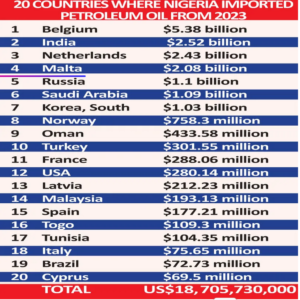

Economists argue that this sustained reliance on petrol imports has continued to undermine the domestic economy. Beyond the pressure it places on foreign exchange reserves, import dependence effectively exports jobs, supporting employment in refining countries while stifling opportunities within Nigeria. This concern is reinforced by an analysis conducted by Statisense, an AI-driven data analytics firm specialising in financial report analysis. The study revealed that in 2023, Nigeria spent approximately $18.7 billion importing petroleum products, including premium motor spirit (PMS), from about 20 countries, several of them within Africa. From just eight African countries, Nigeria spent an estimated $243 million on petroleum imports.
The data further highlight striking trade imbalances. Petroleum imports from Malta alone surged by $2.03 billion to $2.08 billion in 2023, compared with just $47.5 million in 2013. NBS data show that in the third quarter of 2023, Malta ranked among Nigeria’s top five import sources. During that period, Nigeria imported goods worth $561.37 billion from Malta, with petroleum products accounting for roughly one-third of total imports. Overall, petroleum imports were valued at about $36 trillion in 2023, with petrol accounting for approximately 21 per cent of total imports.
However, figures from Trade Map, an online trade statistics database managed by the International Trade Centre (ITC)—a joint agency of the United Nations and the World Trade Organisation—present a slightly different picture of import origins. According to the platform, Nigeria’s largest petrol imports in 2023 came from Togo, valued at $109.3 million, and Tunisia, at $104.35 million. Taken together, these statistics underscore Nigeria’s continued dependence on imported fuel, despite ongoing efforts to expand local refining capacity. Analysts attribute this persistence to a combination of supply chain inefficiencies, demand–supply mismatches, and delays in refinery ramp-up, all of which continue to constrain the transition to self-sufficiency.
Why the preference for importation persists
Stakeholders in the oil and gas sector argue that Nigeria’s continued preference for petrol importation is rooted in decades of underinvestment, operational inefficiencies, and policy inconsistency within the domestic refining industry. The result has been chronically low local output, compounded by a persistent foreign exchange crisis that, at times, makes imported fuel appear more competitive—even with the entry of the Dangote Refinery. These factors have combined to create a complex mix of market distortions, logistical constraints, and regulatory hurdles that keep the country reliant on foreign supplies, despite long-standing aspirations for self-sufficiency.
Nigeria’s state-owned refineries, in particular, have consistently underperformed due to poor maintenance regimes and obsolete technology, leaving them unable to meet national demand. In addition, fuel marketers often find it more economical or operationally convenient to source refined products from international markets, especially when domestic production costs, transportation challenges, or supply-chain inefficiencies undermine the competitiveness of locally refined fuel.
Despite these challenges, Nigeria’s refining landscape has expanded significantly in recent years. The country currently has 30 licensed modular refineries, of which five are operational and producing products such as diesel, kerosene, black oil, and naphtha. About 10 others are at various stages of completion, while the remaining have received licences to establish.
Modular refineries are compact, skid-mounted processing plants designed for rapid deployment and lower capital costs. Using simplified refining processes—primarily distillation—they produce essential fuels and offer a flexible, decentralised alternative to large conventional refineries. Their growth is intended to enhance energy security, reduce transportation costs, and bring refining capacity closer to crude oil production sites. The operational modular refineries include Waltersmith Refining and Petrochemical Company (5,000 barrels per day), Aradel Refinery (11,000 bpd), OPAC Refinery (10,000 bpd), Duport Midstream Refinery (2,500 bpd), and Edo Refinery (6,000 bpd).
On a larger scale, Nigeria’s conventional refineries form the backbone of its historical refining capacity. The Kaduna Refining and Petrochemical Company (KRPC), established in 1980 at a cost of $525 million, was designed to supply petroleum products to Northern Nigeria. Initially built with a capacity of 50,000 bpd, it was expanded in stages to reach a peak capacity of 110,000 bpd by 1986.
The Old Port Harcourt Refinery, commissioned in 1965 with a capacity of 60,000 bpd, was constructed at a cost of approximately £12 million by Shell BP. While it operated above 50 per cent capacity in its early years, output declined steadily from the 1990s. In March 2021, the Federal Government awarded its rehabilitation contract to Italy’s Tecnimont SPA. By December 2024, the Minister of State for Petroleum Resources, Senator Heineken Lokpobiri, announced the mechanical completion and flare start-up of the facility.
The New Port Harcourt Refinery, commissioned in 1985 at a cost of $850 million, added 150,000 bpd to national capacity, bringing the combined Port Harcourt refining capacity to 210,000 bpd. Similarly, the Warri Refinery and Petrochemical Company (WRPC), commissioned in 1978, is a complex conversion refinery with a nameplate capacity of 125,000 bpd. The facility includes a petrochemical plant commissioned in 1988, producing polypropylene and carbon black, and supplies markets across southern and southwestern Nigeria.
Among private operators, Waltersmith Refining and Petrochemical Company in Imo State began operations in 2020 with a capacity of 5,000 bpd and has announced plans to scale up to 50,000 bpd in the coming years. The most significant addition to Nigeria’s refining capacity is the Dangote Refinery, a 650,000-bpd integrated facility located in the Lekki Free Zone, Lagos. Built at a cost of about $20 billion, the refinery was commissioned in May 2023. Crude processing began in December 2023, with refined products supplied to domestic and international markets from May 2024.
Other notable projects include the Azikel Refinery, a 12,000-bpd modular hydro-skimming refinery under development in Yenagoa, Bayelsa State, designed to process Bonny Light crude and Gbarain condensate. The Ogbele Refinery, which started operations in 2012 as a 1,000-bpd topping plant, has since expanded into an 11,000-bpd, three-train facility producing diesel, kerosene, naphtha, and fuel oil. The Edo Refinery and Petrochemical Company, owned by AIPCC Energy, operates in two phases with capacities of 1,000 bpd and 5,000 bpd, and plans a further expansion to 12,000 bpd. Additional modular refineries include Duport Midstream in Edo State, OPAC Refinery in Delta State, and the Aradel modular refinery in the Niger Delta, which produces a range of middle distillates and fuel oils.
The rehabilitation of state-owned refineries and the completion of the Dangote Refinery were widely expected to usher in an era of fuel self-sufficiency and significantly reduce Nigeria’s dependence on imported petroleum products. However, despite these developments, large volumes of refined fuel continue to be imported.
Industry experts attribute this gap between capacity and reality to persistent operational challenges, delayed ramp-up schedules, pricing dynamics, and regulatory constraints. Nonetheless, stakeholders maintain that Nigeria’s expanding refining infrastructure remains critical to achieving long-term energy security. With a growing mix of modular, conventional, and large-scale private refineries, analysts argue that Nigeria is structurally positioned to evolve into a global refining hub—capable not only of meeting domestic demand but also of supplying refined petroleum products to regional and international markets, provided policy coherence and operational efficiency are sustained.
Private investment and profitability constraints
Investor reluctance to commit capital to refining is closely linked to the industry’s narrow profit margins. Refining is a capital-intensive, high-risk business that typically delivers low margins, except during brief periods of favourable market conditions. Returns are cyclical and heavily influenced by global crude prices, exchange rates, and supply disruptions, making refining a complex and uncertain investment proposition. Africa’s richest man and President of Dangote Group, Aliko Dangote, has publicly acknowledged this reality. Speaking during a recent media tour of the Dangote Refinery, he described refining as a low-return venture compared to other global investments. “There is a very low margin as profit on refining business. In fact, if I had invested the amount spent on this refinery on Google, I would have made twice the investment. There is very little money in refining,” Dangote said.
For modular refineries—often described as a critical bridge toward energy self-sufficiency—the profitability challenge is even more pronounced. Many modular refiners are still awaiting their first crude oil allocations, despite the Nigerian National Petroleum Company Limited’s (NNPC Ltd.) pledge to support them as part of government efforts to boost local refining and reduce fuel imports. The delays have forced several operators to run far below installed capacity or rely on alternative, more expensive feedstock sources. While some refiners have turned to third-party suppliers, others have had no choice but to suspend operations altogether.
Industry experts attribute the limited output of modular refineries to a combination of structural and operational constraints. The Vice Chairman of the Crude Oil Refinery-owners Association of Nigeria (CORAN), Mrs. Oludolapo Okulaja, identified key challenges including poor infrastructure, unreliable power supply, weak transportation networks, and inadequate or non-existent pipeline infrastructure—all of which significantly raise operating costs. Although policy incentives such as duty waivers on imported equipment and tax reliefs exist, Okulaja argued that implementation remains inconsistent. “These incentives need to be properly executed within a clear and workable framework that beneficiaries can actually access,” she said.
Echoing these concerns, CORAN’s National Publicity Secretary, Eche Idoko, revealed that modular refineries have yet to receive a single barrel of crude from NNPC Ltd. since the naira-for-crude initiative commenced in October 2024. “As a result, most modular refineries are operating at about 20 per cent capacity,” Idoko said. “They are forced to source feedstock from third parties, which is usually very expensive.” He added that Edo Refinery, for example, relies on trucked crude from third-party suppliers, driving landing costs to nearly four times what they should be. Waltersmith and Aradel refineries, he noted, are able to operate only because they source crude from their own marginal fields—though even that supply is insufficient to fully meet plant requirements.
The naira-for-crude scheme was designed to address precisely these constraints by allowing local refineries to purchase crude oil in naira through NNPC Ltd. Under the arrangement, NNPC says it has supplied about 48 million barrels of crude to the Dangote Refinery. Although the original plan envisaged supplying seven smaller refineries alongside Dangote, only the Dangote facility ultimately benefited—and even it did not receive the full volumes initially agreed.
Okulaja said the situation has become critical. “Both modular refineries and the Dangote Refinery are in urgent need of consistent feedstock. Supplying crude to local refineries should now be a top government priority, so plants can operate at optimal capacity,” she said.
She cited cases where refineries with installed capacities of 10,000 barrels per day—equivalent to 300,000 barrels per month—are allocated as little as 30,000 barrels for an entire month. “That simply does not make sense,” she said. According to Okulaja, local refiners have the potential to transform Nigeria into a net exporter of high-quality petroleum products while simultaneously meeting domestic energy needs. Achieving this, however, requires deliberate policies to expand refining capacity and prioritise in-country value addition. “Refining our crude locally creates far more value than exporting it as raw material, only to import finished products at higher prices and often inferior quality,” she argued.
She identified regulatory bottlenecks, limited access to financing, and inadequate domestic crude supply as the most pressing challenges. In particular, she accused the Nigerian Upstream Petroleum Regulatory Commission (NUPRC) of failing to fully enforce the Domestic Crude Oil Supply Obligations (DCOS) framework, thereby depriving both modular refineries and the Dangote Refinery of reliable feedstock. Okulaja also pointed to Nigeria’s persistently low crude oil production, attributing it partly to theft and vandalism. “Despite decades of oil production, Nigeria has not translated its resources into meaningful national development or wealth,” she said. “The continued reliance on imported, often substandard, petroleum products reflects a failure to adequately support domestic refining.”
Demand versus supply security
Given the sheer scale of the Dangote Refinery, many analysts argue that Nigeria should, in theory, have ended petrol importation. Aliko Dangote has repeatedly stated that his 650,000-barrel-per-day facility can meet 100 per cent of the country’s petrol demand. At about 85 per cent operating capacity, the refinery produces over 57 million litres of petrol daily, compared with national consumption of roughly 50 million litres per day. This excludes the refinery’s strategic reserve of more than one billion litres. Projections indicate that the plant could exceed domestic demand by 15 to 20 million litres daily, potentially reshaping fuel supply across Africa.
However, major marketers caution against relying on a single source for national supply. They argue that operational risks, logistics constraints, and distribution bottlenecks make sole dependence on one refinery impractical. The Executive Secretary of the Major Energies Marketers Association of Nigeria (MEMAN), Clement Isong, confirmed that all member companies currently purchase petrol from the Dangote Refinery. Nonetheless, he stressed that supply timing, logistics, and volume constraints prevent the facility from being Nigeria’s only source of petrol. “It is almost impossible for a single source to meet demand in the way marketers require it—when they want it, how they want it, and in the quantities they need,” Isong said. He explained that while some marketers require ship-to-ship deliveries, others depend on gantry loading, and queuing at a single location inevitably creates bottlenecks. According to him, these challenges have already resulted in temporary fuel shortages at some filling stations operated by major marketers.
The Centre for the Promotion of Private Enterprise (CPPE), however, takes a different view. The economic think-tank argues that exposing local refiners to unrestricted global competition without first addressing structural deficiencies—such as high energy costs, poor infrastructure, and limited access to finance—creates what it describes as a “policy-induced disadvantage.” To ensure that protective measures deliver long-term benefits, CPPE recommends complementary interventions, including low-cost financing, reliable power supply, infrastructure investment, and streamlined regulation. “Protection must be strategic, time-bound, and performance-based,” the group advised, adding that once domestic refineries achieve stability, Nigeria should pivot toward export competitiveness. The centre also called for robust monitoring and evaluation frameworks to ensure that protection drives productivity, innovation, and price moderation, rather than rent-seeking or inefficiency.
…Culled from The Nation